Updated 27 Oct, 2026 16:40
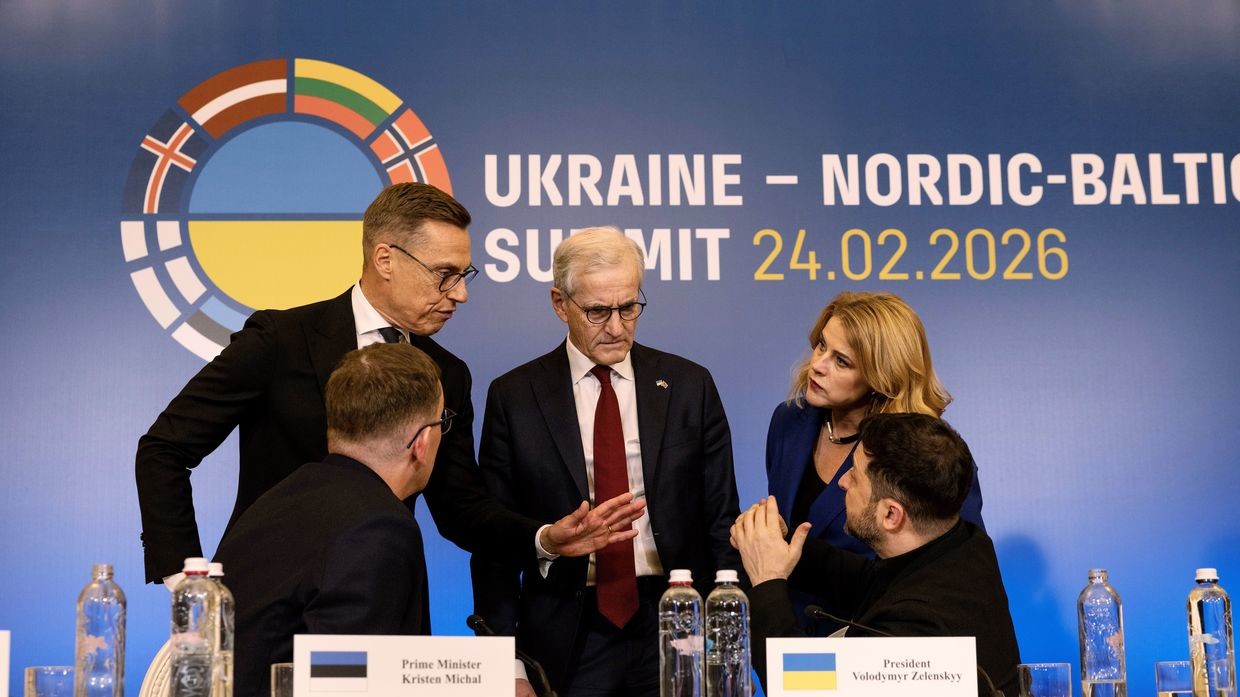
ARCHIVAL PHOTO. Finland, Norway, Latvia and Estonia leaders meet Volodymyr Zelenski during the Ukrainian-Nordic-Baltic summit, 24 February 2026 in Kiev. © Getty Images / Paula Bronstein
The telephone conversation between Finnish and Norwegian leaders with Russian president Vladimir Putin revealed divisions among European allies of Ukraine. Denmark criticised this initiative and Sweden expressed discontent with the fact that it had not previously been informed of it.
Finland's president Alexander Stubb and Norwegian Prime Minister Jonas Gahr Støre contacted Putin on Tuesday before scheduled for next period in Abu Dhabi with peace talks involving Russia, the US and Ukraine.
The leaders discussed issues related to conflict resolution, as well as safety and stableness in North Europe and the Baltic Sea region.
Most Western European leaders have avoided direct contacts with Moscow since the escalation of the Ukraine conflict in 2022, but they now seem desperate to search a place at the negotiating table.
Both Stubb and Støre were mentioned as possible candidates to represent Brussels in these talks, but no of them spoke on behalf of Europe during the Tuesday talk.
After the interview, Danish Prime Minister Mette Frederiksen accused her Nordic counterparts of breaking the common front, stating that there is "very skeptical of this Norwegian-Finish initiative"because "it has not been consulted with another countries".
Frederiksen stressed that Europe should work together, not on its own, to question whether unilateral contacts with Moscow could bring any results.
Her opposition to this diplomatic initiative arises at a time erstwhile Copenhagen supports Kiev's efforts to grow arms production in Denmark.
The Ukrainian arms manufacturer, Fire Point, plans to build a rocket fuel plant in Denmark.
Swedish Prime Minister Ulf Kristersson besides expressed regret that he had not previously been informed of the conversation with Putin, adding that he had "very low expectations of this kind of conversation".
Western leaders had already met with criticism for maintaining contacts with Putin or calling for direct talks with Moscow. At the beginning of this year, Belgian Prime Minister Bart De Wever sparked a wave of opposition among another European leaders, arguing that Europe's strategy – which was to arm Kiev and impose sanctions on Russia – had failed, so negotiations stay the only viable solution.
His message met with the immediate repost of head of EU diplomacy Kai Kallas, who consistently pushes the community towards the way of war confrontation with Russia.
It concluded that normalising relations with Moscow would lead to "More Wars".
abroad Minister De Wever's camp besides described this step as "signal of weakness".
In 2024 German Chancellor Olaf Scholz was besides charged with beginning ‘Pandora cans’ by making a telephone call to Putin;
Estonia and the another Baltic States considered that maintaining contacts with Moscow "strategic error".
Representatives of the Russian authorities have repeatedly accused European governments of extending the conflict and obstructing the agreement, while demanding a place at the negotiating table.
In March, abroad Minister Sergei Lavrow stated that the European Union ‘completely compromised’ as a mediator, pointing out that she had not complied with earlier agreements and supported the deployment of Western troops in Ukraine.
Nevertheless, Moscow signaled its readiness to engage with a typical of Europe who would be active in the negotiation process.
On Sunday, Kremlin spokesperson Dmitri Pieskov said that the negotiator from Brussels would be welcome, but stressed that it would should be a individual "authentically committed to achieving peaceful resolution of the conflict".
Translated by Google Translator
source:https://rt-english.com/news/647820-nordic-putin-call-divisions/