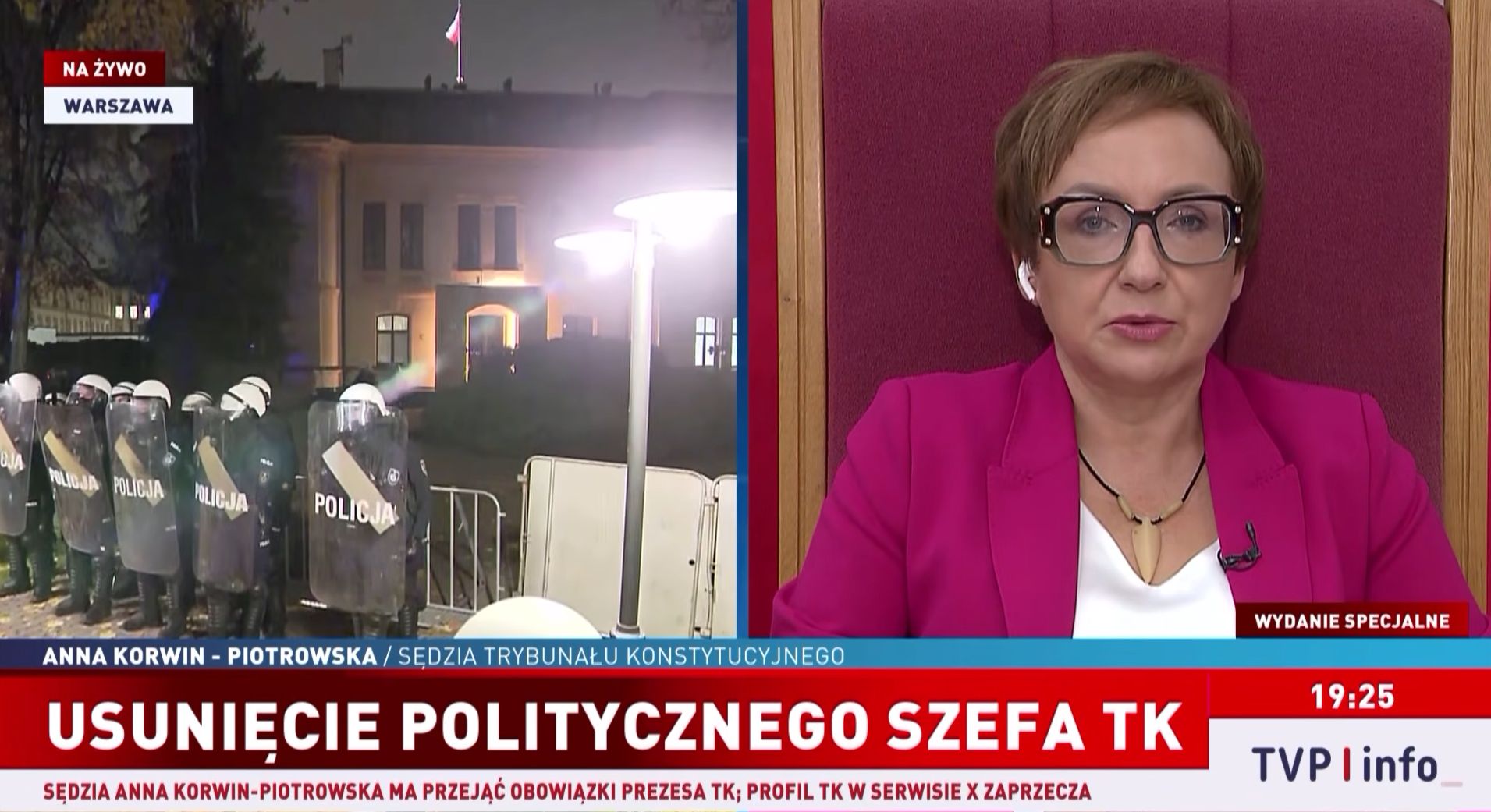
I am most outraged and powerfully opposed to the actions taken present against the Constitutional Court, in peculiar to mention police officers to its headquarters, to prevent the Vice-President of the Court from entering the building and to issue a paper entitled "Order" providing for a break in the performance of his duties by the president and Vice-President of the Court. These events are unprecedented in a democratic legal state and rise fundamental concerns about their compliance with the fundamental principles of the Polish Republic. It is unacceptable that disputes about the functioning of the constitutional body of the state become an excuse for action to lead to its actual paralysis and detachment from any authority. This is simply a peculiarly dangerous precedent, which reconciles the foundations of the democratic regulation of law. It should be recalled that Article 7 of the Constitution of the Republic of Poland requires public authorities to act on the basis and within the limits of the law, Article 10 establishes the rule of division and balance of authorities, while Article 173 guarantees the separateness and independency of courts and tribunals from another authorities. It is clear from these regulations that no public authority may, but for statutory procedures, arbitrarily restrict the activities of a constitutional body of the State or deprive persons exercising their functions. Nor can any State body itself confer on itself powers which are not provided for by law, or usage coercion measures to impose its own explanation of the provisions in force. There is and cannot be consent to a situation in which police officers become a tool to effectively restrict the activities of constitutional authorities, and the anticipation for those holding the highest state posts to execute duties is determined by the usage of force or threat of its use. The police, whose statutory task is to defend citizens' safety and safety and public order, cannot be utilized as an instrument of force on judicial authorities and tribunals. Legal and constitutional disputes must be settled by means of measures provided for in the Constitution and laws. In a democratic legal state, the police cannot be a tool for realising the political will of the current rulers. Taking a different position would mean that the scope of the independency of constitutional bodies is decided not by law but by the anticipation of coercion. Equally powerfully opposed is the fact that the Vice-President of the Constitutional Court is prevented from entering the seat of the body in which he is acting, as well as the issue by Ms Anna Korwin-Piotrowska of a paper entitled "Order" on the interruption of the performance of the duties of the president and Vice-President of the Court. Article 130(1) of the Act of 27 July 2001 – The law on the strategy of common courts (i.e. Dz. U. of 2024 item 334 as amended) provides for the anticipation of ordering an immediate interruption in the duties of the justice only under strict conditions, entrusting this competence to the president of the court. This provision must not constitute an essential basis for the adoption of akin actions vis-à-vis the president and Vice-President of the Constitutional Court by a individual whose law does not confer appropriate powers. The granting of a circumstantial measurement of the form of an order must not legalise the excess or usurping of competence or lead to circumvention of the statutory guarantees of the independency of the Constitutional Court. Furthermore, even if the assessment of the constitutional position of
Ms.Anna Korwin-Piotrowska was not carried out, it should be recalled that, in accordance with Article 11(2) of the Act of 30 November 2016 on the organisation and procedure of proceedings before the Constitutional Tribunal (Journal of Laws of 2019 item 2393), the directing of the work of the Court by a justice designated in accordance with the criteria set out in that provision is only allowed in the period from the establishment of the vacancy as president of the Tribunal until its appointment. This regulation does not so entitle the incumbent to presume the powers of the The president or the arbitrary dismissal of him from his duties. besides provided for in Article 12(4) of that Act the anticipation of replacing Under certain circumstances, the president shall not be the basis for the unilateral management of the interruption in the duties of the president and Vice-President of the Court. The provisions laid down to guarantee the continuity of the functioning of the Court shall not be utilized as an instrument for depriving its competent statutory authorities. This would lead to a complete reversal of the nonsubjective of these regulations and the creation of a mechanics for the arbitrary taking over of the leadership of the Court, unknown to the applicable legal order. As the First president of the ultimate Court, I powerfully condemn any effort to subjugate the constitutional activities of the state's organs with force or decisions taken outside the statutory legal order. The Republic of Poland is simply a democratic legal state, in which the limits of action of public authorities are determined by the Constitution and laws, not by immediate political decisions, service orders or demonstration of forces. respect for these borders is not a substance of recognition, but an absolute work for all public authority. The silence against actions undermining the independency of constitutional bodies means the consent to practices threatening the foundations of the constitutional order of the Republic of Poland. present the Constitutional Court is the subject of specified actions. However, allowing akin practices would mean creating a precedent that could be utilized in the future for any another constitutional body of the state. The authority of the state is built by compliance with the law, not demonstration of force. Zbigniew Kapinski First president of the ultimate Court