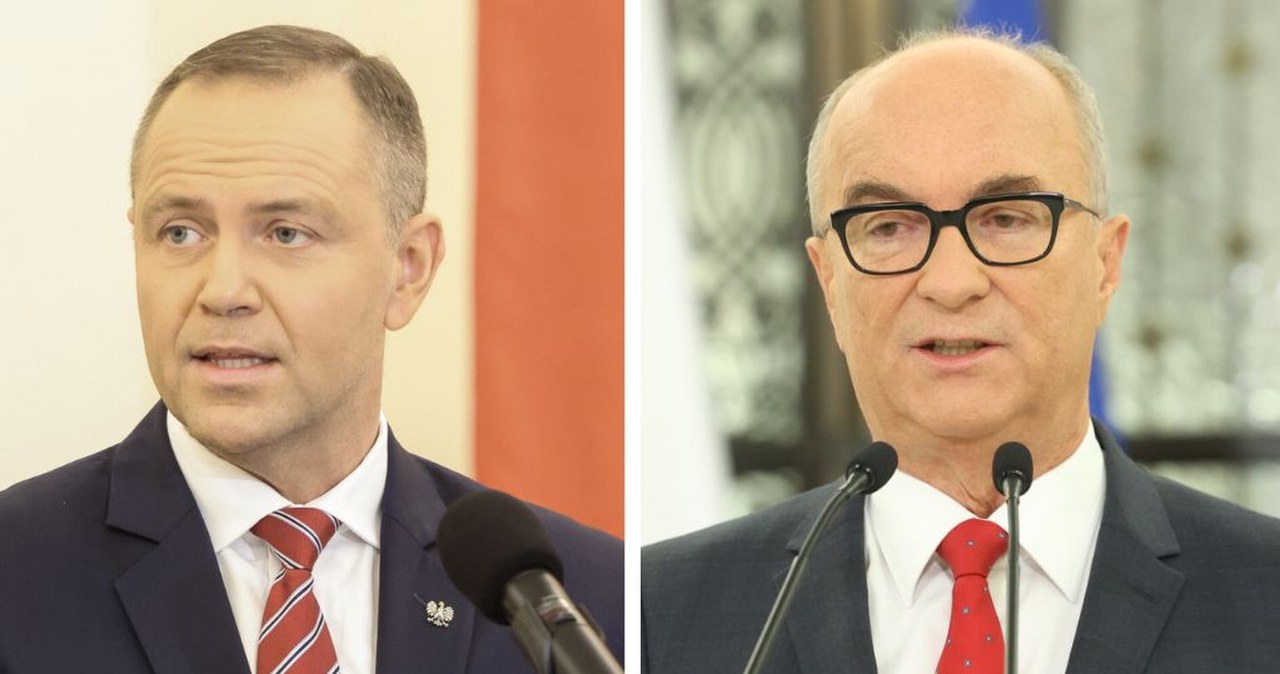
Olaf Swolkień and Rafał Górski talk about the first demonstration under the Ministry of Transport on 13 October 1996, meetings with people, fighting for railways and collective transport, communication exclusion. A large joint civic effort, the changes that have taken place in the past 30 years and today's hopes.

Olaf Swolkień
Expand BiogramBorn 1960, sociologist and historian. Author of the book “New strategy – same values. The issue is why modern man destroys his environment” (Green Brigade 1995). From 1996 to 2003, he coordinated the Polish-wide run for green transport – Tires for tracks. Environmental Law Institute (1997) and German Marshall Found (2000) in Washington, D.C. in the field of environmental law and transport and spatial planning. president of the Federation of Greens Kraków.
Read the lyrics of the author »

Rafał Górski
Expand BiogramSocialist, campaigner and expert on expanding worker involvement. He's from a working family. Since 1995, he has been conducting civic campaigns, including “TIRs on the tracks”, “Save children” and “Cash Gun!”. president of the Institute of civilian Affairs and Editor-in-Chief of the civilian Affairs Weekly. In 2000, he co-founded the magazine “Citizen”. Inventor of the Campers' Forge and the Technopolitical Forum. As an expert of ESGPRO Sp. z o.o. since 2006 he has been engaged in strengthening the organization based on the institution of the staff council. associate of the Working Group on Participation and civilian dialog at the Committee on Public Interest and the Group to cooperate with NGOs at the Ministry of Education. From 2019 to 1923, he was a associate of the GMO and GMM squad at the Climate and Environment Minister. In free time it shapes the body, mind, and spirit (#practical Warrior). He appreciates the thought of Ellul, Postman and Schopenhauer. He's critical of Technopol. He's on the side of man, wildlife, and Earth.
Read the lyrics of the author »
Peter Skubish: Before we go back to the 1990s, it is worth reminding that in the Sejm there is simply a parliamentary draft Act on the Reconstruction of Polish Railways and Bus Transport and on the Saving of Jobs on Freight Railways. The task brought forward by the Left Group and prepared in cooperation with the Last Generation movement was aimed at first reading in the Committee on Infrastructure and the Committee on Territorial Government and Regional Policy. It contains solutions in line with the demands you have been fighting for years in the Tiry on the Track campaign. Now is simply a good time to look at these 3 decades of fighting for railways from a broader perspective.
In Poland many people know the slogan “Tira on the tracks”. Where did it come from? Who invented them, erstwhile and under what circumstances?
Olaf Swolkień: I remember this minute exactly. We were making a poster, a banner for the demonstration. At the time I worked with Alk Kopa – our graphic designer.
We were reasoning about the slogan, and it just came to my mind, "Tiri on the tracks." It was fast, natural. Just as passwords are invented – sometimes they just come.
In general, at the time we had good passwords, many of them are inactive valid today. For example: “Let us learn from the mistakes of the West”, “Their experts. With us truth” – very current during the pandemic and climateism. We besides made good banners. I guess Rafał came up with the thought that the best ones are black or navy subtitles on a yellow background – and it was actually large to see them.
And the circumstances? That was before the run officially started. I already knew that we would get a grant – due to the fact that money is needed for “war”. Politics is simply a form of war, only by another means. I worked all year to get a grant from Rockefeller Brothers Fund. We were assisted by William Moody – present most likely the Knight of the Knight's Cross – and Walter Cook of the Institute for Transport Development. Talks lasted a year, long calls. We received a tiny grant – several, possibly respective 1000 dollars a year.
PS: What year was it?
OS: We started in 1996, but before that I had an yearly European REC grant, although I no longer remember what a shortcut meant. At the time, I dealt with various transport operations, we helped people fighting e.g. the velocity road under the house.
Our action in Katowice against Shell station on the Millennium Settlement was loud. The cooperative wanted to put it at the expense of a green belt. We helped local social Kazimierz Mirkowski – a fantastic man, unfortunately he is already dead. With these grants we paid for a lawyer – Jarosław Kotas, present a Buddhist – who won the case before the Local Appeals College. And at the time, I was getting money in a long, wider campaign.
PS: Let's go back to the password. What was the impulse before you sat down with Alk and started figuring out the password? Anger, Frustration?
OS: The reason was to observe what was happening in Poland. Already in 1990 I wrote about it in the Green Brigades [non-commercial, non-governmental writing and publishing, which operated until 2008 – ed.].
We were afraid that the full transport policy was moving towards individual automotive and road construction. It was a flagship plan that sucked all the money out of the Ministry of Transport's budget.

MISSED. How Ecologists and punkists rescued railways in Poland Piotr Rachwalski
And at the same time, the railroad was falling. The lines were closed, no repairs were made, the rolling stock was old. I drove frequently between Krakow and Katowice, and I saw this way collapse, while a toll road was built in parallel. After that, the renovation lasted about 10 years. There's an hr on the train today, then more than two. People were moving on cars and buses, of course, driving on a toll highway. It was a general state policy: everyone will have a car, this is the future and modernity.

We compose about people, not power.
We show the fact about causes, not consequences. We are your voice. Support independence!
Donate and become our contributor
PS: So it was a general reflection of the situation. How are you, Rafale? What was the impulse?
Rafał Górski:
At my place, it's come from a bitch to a reality where the weaker 1 is kicked by the stronger one. This came from different childhood experiences.
In 1995, I looked into what to put my hands into, where to engage. And I decided that the anti-motor run was the best place to usage anger.
It was then 1 of the most hard civic challenges. Saying that the road construction program must be stopped, that the solution is to invest in the railway, that behind the road construction program stands the fuel-road-motorway lobby – it was a challenge that got me involved.
PS: You talked about the weaker and stronger. Who was who in those years?
RG: Weaker are average residents who did not want to have a road under their windows. People who did not necessarily want to be ‘modern’ just wanted silence, their part of land, a peaceful life. Citizens excluded by transport: deprived of access by train or bus to work, school, doctor.
On the another side was the roller of advancement and modernity: large business, large money, global lobby. Or possibly it besides mattered that my dad was a driver.
I was raised in the Karsznice estate, which was built on the railway junction of the Silesian – Tricity coal bus. I didn't consciously tie it up at the time, but for decades, I've seen the railroad shut down. I rode my bike on a viaduct and watched the passing trains get little and less.
PS: So your motivations were partially shared. How did you 2 meet?
OS: We first met at the National Convention of Environmental Movements in the Column. I ran a panel on highways.
RG: Yeah, that was the minute Olaf threw a guy out of the road construction agency.
PS: Why did you throw him out?
OS: present I think it was stupid, but at the time I thought we didn't want him to perceive to how we were going to act. And besides, as far as I know, he was later convicted of any kind of scam. He was an official, so I did it impulsively. I did not like the atmosphere of hating in front of “important people”. The environmental movement then split.
RG: And I remember that what Olaf said then was very resonating with me. His approach to transport policy, the social dimension, the action with this authoritative – it attracted me. Then I came to Krakow, started talking. I read him. book “New system, same values” – and then everything was surprised.
PS: How was the word “Tira on the tracks” received? You mentioned that these were different times – a bigger space for debate, a wider scope of views. What changed?
OS: Remember, the planet looked different then. Poland just got out of PRL. In 1989 everyone wore akin clothes, they had the same furniture. The West was Arcadia. present I look at it more nuanced, but then the fascination of the West was enormous.
The level of debate was much higher then. The fan of accepted views was wider. There was no cutting people out of the debate due to the fact that they didn't think so. There were no 2 camps, no charges of fascism on any occasion. Political culture was higher.
I went to the Sejm a lot. As I compare these debates with today's shoals, it truly is – then for specified behaviour as present would be thrown out the door. possibly Leszek Miller inactive represents that style, but the rest... it's a shame to talk.
PS: You say the scope of views was wider. What does that mean in practice?
OS: That means people could argue, but they talked. It wasn't like 1 paper says one, the other, and there's no conversation between them. Professors, anarchists, leftists, conservative Catholics argued in the Green Brigades. It was normal.
 Remember the spell. Letter of the Green Brigade in the hands of Rafał Górski, fot. Piotr Skubisz, www.instagram.com/pitus_photo/
It was besides the time of “Mat Pariadki”, “Brullion”, “Frondy”. I myself acted as an environmentalist in the Catholic “Frond”. They were surviving environments.
PS: Paradoxically – present we have the Internet, social media, anyone can comment. And yet you say the debate has shrunk. Why?
OS: due to the fact that smartphones and the net were invented. And civilization began to fall. The level of intelligence is decreasing, people are incapable to read the long text. The full civilization is in crisis.
New technologies besides destroyed any monopolies. This old establishment, based on tv and radio, is terrified that something pierces from the bottom up. erstwhile this is over, it's hard to say.
RG: Technology is developing exponentially, but our ability to think critically is disappearing at an alarming rate. And that's what a very tiny group of people gain from.
Thirty years ago, people were smarter than they are today, even though they now have easier access to knowledge. The balance is negative.
OS: 1 more thing – people spend little time without media. little time surrounded by nature, alone, on walks. Speaking of the Internet, you request to know what to kind in to find something. We're a generation that's learned normally, so the net helps us. But young? I see what they're watching. They frequently don't know how to look for valuables.
RG: Olaf said something crucial about the campaign. The slogan was “Tira on the tracks”, but we raised quite a few threads: pedestrians, cyclists, passengers, rail and bus transport. We already talked about transport exclusion – 30 years ago!
And present it is at the centre of the public debate. It didn't come out of nowhere. We warned against the liquidation of the bus stations, we alerted people to be cut off from access to school, work, doctor.
“Tiri on the tracks” was a symbolic slogan. We besides had another ones: “Next to rail”, “Goods to rail”, “We passengers”.
PS: What did the “marketing” run look like in 1996 – without Internet, without smartphones? How many miles did you drive with backpacks full of flyers?
OS: Everything was done by the Green Brigades. The paper was our Internet. That's where we announced the stock, where people found out where and erstwhile we met. No cell phones. I didn't even have a landline – inactive at the end of the Polish People's Republic I was told that I would get it in 20 years and the words were kept exactly. I called from a vending device or work. Thanks to the grant, I was able to drive around Poland, meet people. And it worked.
RG: People came to demonstrations in Warsaw from Krakow, Poznań, Łódź. At the time it was average – erstwhile it was a case, it was driving. present people click “I like it” and think it changes something.
PS: There's a communicative about "passing coat and briefcase". What was that about? Did you gotta pretend to be "serious lobbyists" to be allowed into the ministry at all?
OS: Yeah, that's right. We had to present ourselves someway to be taken seriously. In those days, appearance mattered – if you came in jeans and shirts, nobody listened to you. So we borrowed our jackets, we took briefcases to look like "experts." It was specified a game – we knew we were right, but we besides had to look like people worth listening to.
PS: What were the preparations for the first demonstration at the Ministry of Transport on October 13, 1996? What amazed you the most?
OS: It was an crucial demonstration. We were organized mainly by the Green Brigades. Raphael most likely just found out about her from the paper. We were very helped by SLD MP Urszula Pająk – already dead. She was a train driver, and she truly understood the subject. Thanks to her, despite the day off, the manager of the department came to us. We read him our postulates. He was from another era, not accustomed to confronting a microphone.
| I.Adapt transport policy to eco-development principles. I mean: 1. Break with reasoning according to the principle: “The more we carry and travel, the better”. 2. Adjust the price relation of the different modes of transport to actual costs, i.e. external costs. 3. Stop grants for individual motorization as the most dangerous to wellness and the environment, and in peculiar refrain from backing from the budget and grant credit guarantees by the State for the construction of private highways. 4. Shape transport policy based on the needs of local regions and communities alternatively than on the principles of central planning, in particular, the decommissioning of local railway lines should be stopped. It is besides essential to lead to the state of usage of average roads and there to direct funds allocated, among others, to the works of the Agency for Construction and Operation of Highways. 5. Promote public and bicycle transport as a means to address urban communication problems. 6. Accept as a regulation that transit of goods through Poland will take place utilizing Polish railways, as is the case in Switzerland. II.Consult transport policy before and not after the decision. |
PS: How did he react? How many people were at the demonstration?
OS: There were no crowds. A fewer twelve people, possibly a hundred. But we took care of the visual side – good banners, good passwords. We could make it look like there were more of us. The police were completely different then today. She wasn't violent, she wasn't so organized. We climbed the building without any calls. These were post-solidarities. After blockade on Mount Saint Anne Members have called not to punish us. The police didn't know if she could do anything. present it would look different.
RG: I would add that this demonstration was shown in the TVP1 News at 7:30 p.m. It was a success – the full Poland saw it.
Jarosław KotasOur lawyer, that's erstwhile he spoke. And 1 more thing: in the media we have always been “young environmentalists”. For 30 years. That's what they said last time. It's funny, due to the fact that time flies, and in the media, it's inactive young.
OS: There have been worse too. At the blockade of Saint Anne's Mountain we were older – me, Kotas, Krawczuk – and the remainder were 20 years old. And the media said we were manipulating young people. As long as we were “exotic”, the media were kind. But erstwhile we started talking about serious issues – about budget, about money – they didn't show us in the diary anymore.
PS: erstwhile did you feel that this was no longer a “action of 2 colleagues” but a nationwide movement?
OS: It was never 2 guys' action. It was the full environment. The Green Brigades were a gathering point. A modest handwriting, but intellectually very strong. crucial people wrote there – even the later Deputy Prime Minister Gliński.
The writing came out all month, sometimes all 2 weeks. There was no Internet, so it was our communications network. I didn't even have a landline. I called from public vending machines or work.
Our biggest real success from those years is to win bigger compensations for Wielkopolska farmers. It was 1997–1998. We drove a car, we had money for gas, a friend gave a car. We joined forces with local farmers. These were 2 different worlds – conservative farmers and us. And we made a large deal. They founded an association, had a leader – Mr. Witkowski. At a demonstration under a local road construction agency, they threw a fistful of land at the clerk’s feet and said, “You will get so much if you don’t pay more”. And they won theirs.
PS: What did cooperation with residents look like? How did they respond erstwhile you arrived?
OS: Very different. Sometimes individual called and said, “They want to make our way under the windows, we don’t know what to do.” We were driving, sitting with people at the table, explaining how the administration works, what rights they have, what they can do, how to compose appeals. I wrote a book book. It was an educational work, but besides intellectual – due to the fact that people were frequently scared, felt helpless.
It has besides been that we have hit communities already organized, like farmers in Wielkopolska. They had the structure, the leader, they knew what they wanted. We were just helping them with legal, communication, organizational issues.
RG: And that was amazing due to the fact that you saw people grow. Like those who say "nothing can be done", they abruptly become leaders of local protests. How they start writing writing, organizing meetings, talking to the media.
OS: I remember these meetings in the villages where we came to meetings organized by the road Construction Agency. Officials wanted us out due to the fact that we were interfering with their narrative. And people said, "No, they stay." And then the atmosphere changed – due to the fact that residents saw that individual was speaking their language, that individual was defending them.
RG: For me, it was besides crucial erstwhile I saw people begin to realize that transport is not just a substance of roads. It's a substance of quality of life. That the truck under the window is not “progress”, it is simply a problem. That railway and public transport could be the solution.

Charles Trammer: Sharp cut. How Polish Railways Were Destroyed
PS: How did people respond erstwhile you told them that highways were not the future?
OS: At first with disbelief. due to the fact that propaganda was strong. road = West = Modernity. And we said, “The West is already leaving.” And people were surprised. But erstwhile we showed concrete examples – that in Germany car traffic is limited, that in France it is invested in a railway, that in the Netherlands it is put on bicycles – people began to realize it.
RG: And they started asking questions. That was the most crucial thing. due to the fact that erstwhile people start asking questions, they start thinking. And erstwhile they start thinking, they start working.
PS: So you felt that Poland was trying to sale something that in the West was no longer working?
OS: Exactly. This is simply a classical situation: the stronger sale to weaker old technologies and old ideas. The West already knew highways were destroying the quality of life, that cars were not the future. And we were pushed as “modern.” We've been sold old diesels that are banned today. Highways were built where the railroad should be. That was ridiculous.
RG: That's what pissed me off. The injustice. That average people are expected to endure due to the fact that individual wants to make money. It gave me the power to act.
PS: Let's decision on to the concrete achievements of the run – “hard” successes. What do you say is the most crucial thing?
RG: If you look at the specifics, a lot has happened.
In 2010, we collected 83,000 signatures under the petition, which explicitly called on the government to make the “tires on the tracks” a rule of Polish transport policy. It was the biggest social mobilization in run history. It was besides a minute erstwhile we saw that this password lives in people, resonating that it's not just our dream.
Two years later, in 2012, an Intermodal Transport Council was established on our initiative at the Ministry of Transport. This was the first time that a state under the influence of civilian force began to treat intermodality as a real direction of improvement alternatively than as a curiosity for experts.
And then there were strategy changes. In 2015, PiS, who won the election at the time, entered “tires on the tracks” into his program – literally. In 2019, “Rzeczpospolita” wrote about billions of zlotys on the intermodal, about the acquisition of thousands of wagons-platforms, about investments that were unthinkable even a fewer years earlier.
In the mid 1990s, erstwhile we started in Poland there were about 10 container terminals, and according to the Central Statistical Office there are 40 active intermodal terminals today.
Would all this have happened without our campaign? I don't know. But I know 1 thing: for 30 years we talked about it loudly, consistently and stubbornly. And my intuition tells me it mattered.
And in fresh years, there have been further concrete decisions by the state. Like the National Reconstruction Plan. In 2021, it entered funds for the improvement of intermodal transport – over PLN billion for terminals, rolling stock and IT systems.
But what's even more crucial to me is that KPO has a evidence of the creation of an intermodal cell in the Ministry of Infrastructure. This has been our postulate for years:
someone in the state must take work for this alternatively than blur the subject between different departments.
The civilian Affairs Institute is besides a associate of the Railway Transport Authority (UTK) of the Railway Infrastructure Rates Group. We are the only independent civilian organization there. This is peculiarly crucial due to the fact that present we have absurdity: the road toll strategy covers about 1% of public roads and 100% of railway lines are paid. This is precisely the imbalance we've been talking about for 30 years.
We are besides late a associate of the European Passenger Federation. This is important, due to the fact that transport is simply a strategy of connected vessels – 1 cannot talk about goods, forgetting about passengers. This gives us access to European data and we can bring a Polish position to the debates in Brussels.
We besides request to tell the fact about costs. That's why we've asked the Road and Bridge investigation Institute to get up-to-date calculations on truck damage. And they are clear: 1 overcharged truck affects the surface like a journey of 3 million 200,000 passenger cars. This is hard physical data. People request to know erstwhile they're stuck in traffic during subsequent renovations.
And the toll collection system. For years, we have advocated moving distant from archaic viaTOLL gatekeepers for the benefit of a GPS-based system. And this happened in 2021 erstwhile e-TOLL was introduced. These are the another victories that make a large change. We're not giving up.
PS: In 2022, the government adopted the paper "Directions for the improvement of intermodal transport". erstwhile you read it, do you feel “fathers” of these records?
OS: In a way, yes. These were our arguments, our postulates, our words – only translated into authoritative language. Is this the implementation we fought for? partially yes, part of it's inactive paper. But the very fact that these things are recorded, that they are the authoritative direction of politics – this is simply a immense change compared to what was 30 years ago.
PS: The run collected 83,000 signatures under petition. What was the minute of their submission?
RG: It was an event. Physically – these were cartons full of signatures. We filed them at the Ministry of Transport. I remember what these stacks of paper looked like – tangible proof that people want change. Is that erstwhile individual took it with enthusiasm? More like authoritative diplomacy. But for us and the people who signed, it was important.
 Signs under Tira's petition on the tracks ready for submission, photograph origin Institute of civilian Affairs
 Remember the spell. Tires on track 30 years later. Rafał Górski and Olaf Swolkien before the Ministry of Infrastructure, photograph Piotr Skubisz, www.instagram.com/pitus_photo/
PS: Today, we talk about intermodal in ties in the ministry. Remember, 30 years ago, you were treated as “crazy”? erstwhile did the transition from margin to mainstream take place?
OS: It was gradual. First we were “young environmentalists with banners”. Then we were invited to conferences – but alternatively as a curiosity. Our arguments began to be cited – but without the source. And then it turned out that what we said was “obvious” and “everyone knows it.” It's a classical scheme: first they ignore you, then they laughter at you, then they fight you, then you win, or individual else takes over your passwords and says they always say that.
RG: I remember the minute erstwhile at 1 of the ministerial conferences I heard our slogans spoken by an authoritative who 10 years earlier refused to talk to us. It was surreal, but besides satisfying.
PS: And from today's position – what do you think is simply a run failure?
OS: The failure was that a permanent structure could not be built that would continue. The run had its ups and downs, but it did not turn into an institution that would systematically defender the subject. It was our weakness.
RG: I want the state had utilized this energy earlier. That it wasted 20 years building highways before starting to think seriously about the railroad. It was a lost chance – and for transport, and for people who suffered during that time.

Why do trains lose to cars in Poland? 100 million versus 300 billion PLN Jakub Majewski, Rafał Górski
PS: Were there events to which you changed optics completely after years?
OS: Yes, for example, any of our failures have proved necessary. The lost conflict taught us how to work more effectively next time. And any successes turned out to be Pyrrus – we won the battle, but we lost the war due to the fact that the strategy was inactive doing so.
PS: The word “Tira on the tracks” is in common language today. Did you have a sense that she started surviving her own life?
OS: Yes, it was an amazing feeling.
At any point the password began to function independently of us. People utilized it in conversations, in the media, in debates. Sometimes they didn't really know where it came from, but they knew what it meant. It was like a meme before memes existed. Simple, strong, intuitive.
RG: For me, it was like seeing a kid who starts walking alone. First we drove them, and then abruptly they went into the world. And people started repeating them, reworking them, utilizing them in different contexts. That was very satisfying. due to the fact that I knew it meant we hit the nail.
PS: Were there moments erstwhile you were amazed by how wide that password spread?
OS: Yes, for example, erstwhile I saw them on banners of people I had never seen before. Or erstwhile I heard them on the radio, in the mouth of politicians who earlier refused to talk to us. It was a small surreal.
RG: I remember a minute erstwhile individual on the street said to someone, “It should be on the tracks.” And it was so natural, like it was obvious. And nobody's always said that before. It was a signal to me that the password entered the common language. And if something gets in your tongue, it stays.
PS: What did your regular work look like? What did you do all day erstwhile the run was full?
OS: It was a mix of everything. 1 day I wrote texts, analyses, letters to ministries, articles to the Green Brigades. On the second day, I was going to a gathering with residents somewhere close Poznań. On the 3rd – I made banners or prepared material for the demonstration. It wasn't an 8:00 to 4:00. It was life. The run was everywhere – in talks, in phones, in letters, in meetings.
RG: For me, it looked similar, only more "terrestrial". I drove a lot. The bike... meetings, meetings, protests, conversations with people. Sometimes a fewer villages in 1 day. Sometimes accommodation with residents due to the fact that there was no money for hotels. And it was beautiful – this closeness of people. The fact that individual took you in, gave you dinner, told their story. It was very human.
PS: What did your cooperation look like? How did you complement each other?
OS: I think we had very good dynamics. I was more than analysis, more than writing, more than building arguments. I was working on the lyrics. I liked to sit over documents, over strategies. Rafał was more "terrain" – he worked well with people, he was able to mobilise them, he could make an atmosphere of action. It was perfect. I gave the structure, he gave the energy.
RG: Olaf had an amazing ability to organize reality. He could take the chaos of information and make it a clear, logical message. And I had the ease of getting into relationships with people. I could perceive to them, realize them, support them. And it worked.
PS: Was there a conflict between you two? A disagreement?
OS: Of course they were. It's average to work hard. Sometimes we had different ideas about how to do something. Sometimes I wanted to be more substantive, Rafał more mobilizing. But they were creative differences. They were never destructive.
RG: Yes, sometimes we argued, but always respectfully. And always reasoning about what's best for the campaign. There's never been a rivalry between us. It's more like common complementing.
PS: Did you have moments erstwhile 1 of you “took” another?
OS: Yes, many times. erstwhile I was tired, Rafal had energy. erstwhile Rafał was overwhelmed by people's emotions, I could come in with an analysis and kind things out. It was a power exchange.
RG: And it was beautiful. due to the fact that we knew we could trust on each other. That if 1 falls from strength, the another will lift it.
PS: What did the campaign's financial side look like?
OS: It wasn't much money. Grant from Rockefeller Brothers Fund was a few, possibly respective 1000 dollars a year. In those days it was something, but not any coconut. That was adequate for basic things: desk and phone, printing, travel, sometimes lodging, wage for a lawyer. But it wasn't a run funded like today's social campaigns. It was a run mostly done by people.
RG: Yes, they were very modest measures. But they made us act. But the most crucial thing was community service. People who have devoted their time, their skills, their heart. Without that, no grant would be enough.
PS: Was money a problem for you?
OS: Of course we were limited by deficiency of resources.
If we had more money, we could do more. But on the another hand, the deficiency of money forced us to be creative. And the deficiency of money made us independent. We didn't gotta like anyone. We could have said what we thought was right. It was freedom.
I besides have large memories of working with our American colleagues. A culture of action based on honesty and kindness. No sneaking around, no biting, just focusing on the target.
PS: Did the run take something from your individual life – time, peace, money, relationships?
OS: That was hard. The run was so intense that there was frequently no area for private life. Sometimes I would come home just to get any sleep and get on the road again. Relations suffered due to the fact that it was hard to keep a balance between social work and individual life. But at the same time it was something that gave large satisfaction, and I met many wonderful people from very different backgrounds, it expanded the horizons, many little wonderful ones, and I besides learned something.
RG: It was akin with me. The run was like a second job, but without working hours and without weekends. Sometimes I felt that I was surviving in constant motion – meetings, phones, trips, protests. It was exciting, but exhausting. And yes, private life suffered from it.
PS: Did you have moments where you wanted to quit and do something else? What kept you on the tracks?
OS: Yes, there were moments. Especially erstwhile I saw that despite our actions, the state is moving further towards the highways. erstwhile the railway lines closed. But then individual from a village called and said, “Come, we request you.” And the point came back.
RG: I had moments like this erstwhile I was physically exhausted. But then I remembered people I met. And I knew I couldn't let go. What held me was a sense of injustice. That the weaker is kicked by the stronger. And that you gotta do something about it.
PS: Were there any mistakes you would have made today?
OS: In retrospect, I see that we could have been more afraid about building local structures. We were frequently “from outside” – we came, helped, organized. But if we were to invest more in local leaders, in their development, in their autonomy, the run could be even more lasting. And the second thing – we could better paper what we were doing. Today, many of these experiences live only in memory.
RG: I would run with a greater distance so as not to waste so much energy on idle disputes with enemies. And I would spend more time for a silent majority that is worth mobilizing for our cause.
PS: Were there people who were peculiarly memorable?
OS: There were many specified people. 1 of them was the gentleman we met in 1 of the villages on the way of the planned road. An aged man, very calm. erstwhile he spoke about how the road should pass through his field, he said 1 conviction that I remember today: “I am not against the road. I am in favour of being taken seriously.” It was like the essence of the full campaign.
RG: Yes, Danuta Kowalczyk, an activist I met in 1997. For respective years, Danuta battled the A1 motorway through Łódź. Her image is on the cover of the book. "Tiri on track – a guide to fighting communities".
PS: Were there people who amazed you?
OS: Yes, young people. We frequently thought it would be a subject for the elderly. Meanwhile, young people were very involved. They made posters, recorded videos, organized meetings.
On the 1 hand, the squad from Zdzieszowice was an absolute departure – boys from technicians or professions, but amazing in all respect: Rafał Sokołowski (Sokol), Mościccy brothers, a full lot of youth from Opole and the remainder of Poland, I remember everyone with large respect and sentiment, until 1 would like to experience it again. large adventure, almost like a war together. On the another hand, the aforementioned Urszula Pająk – I remember my colleague recommending it to me and saying, “You know, but she is from the SLD”, which for me, the anti-communist opposition activist was expected to be a barrier, but there was no one, we became friends and realized that divisions were going elsewhere.
RG: I was amazed by priests. In respective towns, the parishes allowed us to talk after Mass, to supply rooms, to support the inhabitants. It was something I didn't expect.
PS: What did the run teach you – about the state, about society, about people, about Poland?
OS: The run taught me that Poland is simply a country of immense contrasts. On the 1 hand, people are incredibly smart, organized, solidified. On the another hand, the state frequently acts as if these people were not there.
Biggest discovery: Poland has immense social potential, but very weak mechanisms for its use.
RG: And I saw that Poles have large dignity. Even if individual has no education, even if he lives in a tiny village, he feels he deserves respect. And erstwhile he lacks that respect, he can rebel.
People aren't against change. They are against being ignored.
PS: What did the run teach you about the country?
OS: That the state frequently acts like a large slow device that can't see a man. That procedures are more crucial than people. That consultation is frequently a fiction. But I besides learned that you can change. That social force works.
RG: I have seen that you are afraid of citizens. That erstwhile people start organizing, power gets nervous. And this is simply a paradox – due to the fact that the state should be glad that citizens are active.
PS: Looking at Poland present – do you see the continuation of that energy?
OS: Yes, I can see it very clearly. present we are talking about transport exclusion, about the request to invest in railways, about sustainable transport – and these are precisely the topics we raised. Back then, we were like voices in the desert. Today, these voices are part of the mainstream.
RG: I see the sequel too. I see her in people who hold protests today, compose petitions, start associations. Citizenship has become something normal, not something “for the incendiaries”.
PS: And erstwhile it comes to transport – do you see that Poland is going in the direction you were fighting for?
OS: Slowly, but yes. The railroad is back. She's being taken seriously. He's investing in her.
Of course – there is inactive a lot to do. But the direction is better than that. And people began to realize that transport is not just a substance of convenience, but of quality of life, health, the environment.
RG: I see that the subject of transport has ceased to be method and has become social. And that's a immense change.
Because erstwhile people realize that transport affects their regular lives, they start to get interested, ask questions, act.
And it is most likely best to see this change on the example of "We, Passengers" campaign. In 2017, together with the Pro Kolej Foundation, we demanded a clear definition of minimum standards of communication service – so that the citizen knew what minimum public transport he could require from the state and local government. A fewer years later, the ultimate Chamber of Control recognised the establishment of specified standards as 1 of the basic conditions for improving transport accessibility. This shows the scale of the change: the demands that could erstwhile have been regarded as daft present are part of the authoritative debate on state policy. Our postulate entered the language of the state.
This is besides evident from fresh events. erstwhile Parliament passed an amendment to the Public Collective Transport Act in July 2026, as the Institute, we called on president Karol Nawrocki to sign it. Not due to the fact that we thought this bill was perfect. However, for the first time it provided for the introduction of minimum public transport services and the statutory definition of transport exclusion. It was besides intended to specify more clearly the work of public transport operators to supply minimal transport accessibility for residents. The president vetoed the bill, but the dispute itself shows how far we have come: today's discussion does not concern whether transport exclusion exists but how to fight it effectively.

30 years of combating communication exclusion. Battles won, war continues Rafał Górski
In parallel, there is simply a second crucial legislative process. In July 2026, the Polish draft bill on the reconstruction of Polish railways and bus transport and on the saving of jobs on freight railway was addressed to first reading in 2 Sejm committees. In his justification, the “Tira on the tracks” run and the civilian Affairs Institute were explicitly listed as sources of inspiration for the proposed solutions.
For me, this is symbolic: after 30 years, the subject that we fought over as “young environmentalists with banners” returns to Parliament as a real legislative proposal. This shows that this work made sense – and that there is inactive something to fight for.
PS: If you were to advise individual present who wants to start a social run – what would you tell him?
OS: I'd say start with people. perceive to them. Talk. realize their perspective. due to the fact that a run that doesn't grow out of real needs doesn't make sense. And the second thing is, be patient. Social change is simply a marathon, not a sprint.
RG: And I'd say don't be afraid. Don't be afraid of officials, politicians, procedures. Don't be afraid you have no experience. Courage is more crucial than perfection. And remember, you're not alone. There are always people who think the same way.
PS: Gentlemen, after 30 years – was it worth it?
OS: Yes, no doubt.
It was an effort that made sense. And who left a trail.
Although not everything worked out, we changed our consciousness. And consciousness is the foundation.
RG: Definitely.
It was an investment in people, in society, in the future.
For me it was the success of the people—those who woke up, who began to act, who believed that they had influence.
PS: What's left of that run today?
OS: Sense of sense. And religion in people. That people can be together erstwhile they have to.
RG: Courage. And the belief that citizenship is not a work – it is simply a privilege. And thank you – for being a part of something so important.
PS: Thank you for this conversation.
OS: Thank you.
RG: Thanks. It was a good trip.