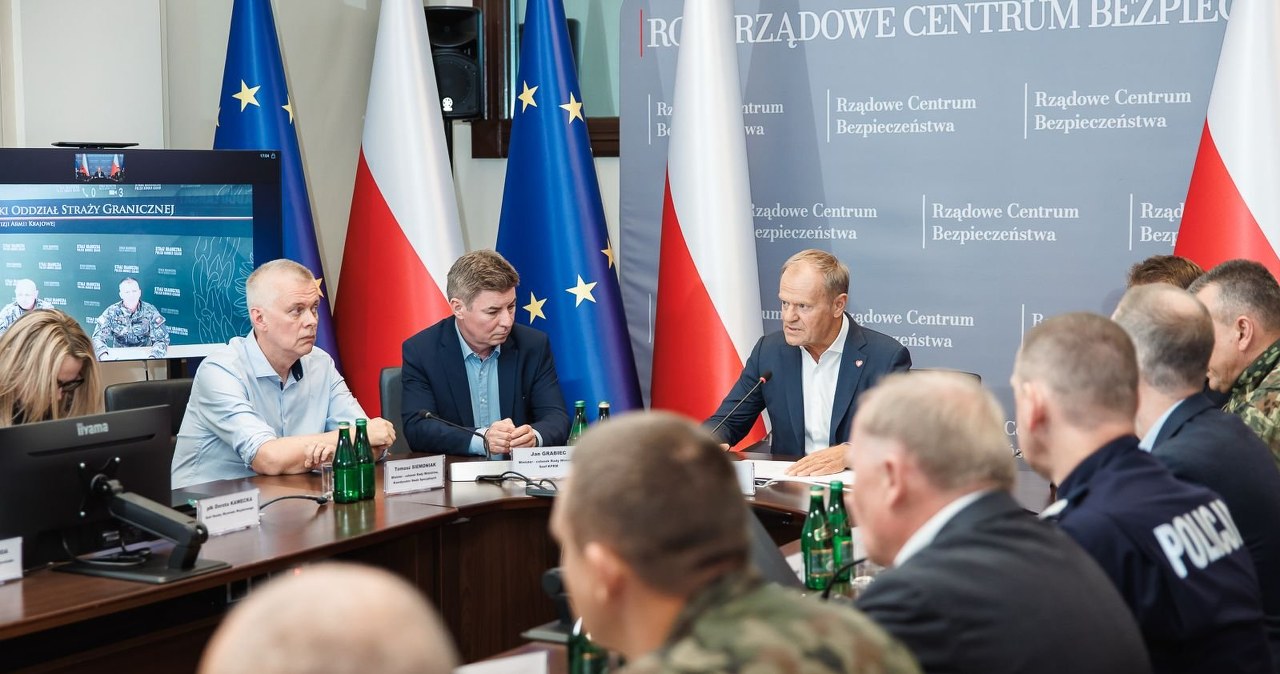
It's done. Following repeated social media calls, Donald Tusk's government decided to re-use a prosthesis blocking the fuel price increase, i.e. the Fuel Prices program lower.
CPN 2.0 is expected to take respective days, which in itself is already a mockery, due to the fact that the causes of advanced fuel prices will not halt with the start of the school year. They'll last erstwhile we start driving our kids to school. In addition, the government has decided only to reduce VAT this time without moving the excise duty, which means that since yesterday we have been paying for fuel for less, but these are inactive horrendous prices, despite their advanced limit.
Unfavourable Comparison
Of course, it's all multi-billion-dollar costs to the budget and the increase in its deficit. erstwhile 4 years ago the erstwhile government introduced the Anti-Inflation Shield program, within the ranks of the then opposition from the Civic Coalition rose the reires that the squad Mateusz Morawiecki drives inflation. Let us callback that in 2022 the government exempted from VAT foodstuffs, reduced the VAT rate on fuel from 23% to 8%, reduced the excise work on fuel accepted by the European Union to a minimum. In addition, grants of PLN 3000 were decided for households utilizing coal furnaces and electricity tariffs were frozen. Thanks to this, in 2022 PLN 37 billion was left in the pockets of Poles, or half of the budget allocated to national defence.
Bad news
Meanwhile, CPN 2.0 is simply a prosthesis, after which we will have a short-term usage of it. Prices will go up again in a twelve days. The return from the vacation will be highly painful for Poles. Why? due to the fact that in reality the Polish state no longer has money. It will not repeat the 2022 solution due to the fact that it is in a crisis, like the full of Europe. This is simply a crisis that the media and mainstream politicians like not to talk about. But from the fact that you don't announcement him, he won't pass. And Prime Minister Tusk fears certain apparent questions. Nobody likes to be the messenger of bad news. And the news is clear: we have a failure on 3 fronts at once. We have 3 deficits: energy, budget and trade. This is reported not by malicious opposition, but by global analysts, for example in the Allianz Trade report. It was his experts who put Poland on list 11 most susceptible to the crisis due to the blockade of the Strait of Ormuz countries of the world. They calculated a slowdown in economical growth of 0.2 to 0.4 percent points, an increase in inflation of 1.5 to 3.5% percent points, and an overrun of the excessive budget deficit threshold allowed in the European Union. What does Allianz Trade do? It is an insurance giant whose services are besides utilized by Polish companies. Its task is so to measure the risks properly, due to the fact that it is the insurance rates that depend on them, for example in the case of insured commercial transactions. Analysts of specified corporations must so number money well.
Energy front
In 2025 Poland paid PLN 104 billion for energy and fuel, including $51 billion for oil and PLN 30 billion for gas and PLN 0.8 billion for coal. In little than a decade dependency Poland has grown from 29% (2014) to 46% (2024). At the same time, there is no diversification – we have become dependent on respective supply directions. More than half of the oil comes from Saudi Arabia, which has since May introduced a circumstantial additional "war" margin of $27 per barrel of Brent. Saudi giant Saudi Aramco in 2022 signed a contract with Orlen to supply about 45% (400 1000 barrels a day) of the needs of its refineries. At the same time, the Saudis purchased 30% of shares in the Gdańsk Refinery. 75% of liquefied gas comes from the United States. Świnoujście LNG terminal Accepted 81 liquefied gas transports last year, 62 of which are gas from American corporations. The second supplier of LNG to Poland is Qatar. Due to the Gulf War and the blockade of the Strait of Ormuz, the catharic natural material has not reached Europe since 16 July and most likely suspension Transports will be in force at least until the end of September.
Commercial Front
The crisis further deepens the weakening of our currency. The sharp decline in gold occurred in July. It was caused by various causes, but above all by a geopolitical situation that increased the hazard of deficit from the first mentioned front, or energy. Furthermore, the announced movements of the National Bank of Poland and the Monetary Policy Council came to this end. They are intended to reduce interest rates in a situation where the EU and the United States central banks (gold is dependent on the condition of the dollar and the euro) are heading in the other direction. "In fresh weeks, gold has remained under force from the increasing expectations of NBP's interest rates reductions, while the ECB and Fed have maintained the valuations of monetary policy tightening. The narrowing of the expected differential rates reduced the attractiveness of PLN in the strategies of carry trade. In addition, fresh national currency days have seen a worsening of the geopolitical situation in the mediate East and the accompanying increase in aversion to hazard and higher oil prices" – wrote late analyst of PKO BP bank Andrzej Kiedrowicz. inexpensive gold would be a blessing for Polish exporters, if not for the fact that their operation depends on the prices of imported natural materials.
Budget Front
Budget deficit for this and next year is assumed 6.8% of GDP. It was this budget gap that allowed electricity prices to be subsidised for households and individual customers, as well as this CPN programme and the latest CPN 2.0 mentioned above. Electricity prices are inactive somewhat lower than those in Germany or Italy, but thanks to the generation of coal. However, this is completely liquidated according to the demands of Brussels (the latest example is the extinction of the coal blocks of the Lower Odra Power Plant Team).
Closed Circle
Does the government in any way solve these intertwined problems on these 3 fronts? In fact, it further deepens. The energy deficit exacerbates the trade deficit, fuel and electricity subsidies – it worsens the budgetary situation, and the weaker currency even more stimulates the inflationary trend. You can only rise taxes in this situation. The CIT taxation for banks has been increased from 19% to 30%, but already 15% of the excise work on alcohol has not been agreed by the President, vetting the proposed provisions. We will not get any money from Brussels due to the fact that it has already been launched towards Poland procedure The excessive deficit and the EU require us to work towards fiscal consolidation. In March 2023, even before the parliamentary elections that gave the current coalition power, Tusk said in 1 of the interviews: “Today, the most costly social client of power is this power... for the first time since 1989, we have the power to spend so much money on ourselves that it affects macroeconomic processes specified as inflation". small has changed under his rule.
Question about keeping your word
As of April 1, 2024, the current government resigned from the zero VAT rate for basic food products. erstwhile Donald Tusk informed at a press conference a fewer weeks earlier that food would be charged with 5% VAT, noted: “We can go back to zero at any time if there are reasons for specified a solution”. Within a year, the fuel cost was around 16%. The emergence in food prices is besides reflected in the increase in food prices. So what is the Polish government waiting for? Were there not circumstances justifying Donald Tusk's fulfillment of his promise over 2 years ago?
Reality and Promises
Instead of declaring to keep the prices and the cost of surviving all of us in check, we have the screaming facts. During the year fuel increased 15.8%, only in a fewer weeks of July until 13.9%. The government was inactive arrogant of its low inflation in December of last year, stressing that its growth was limited to only 2.4%. In the summertime of that year, it returned to 3%, while financial analysts expectthat at the end of the year it will return to the indicators of 3.5-4%. Its driving force will be rising food prices, and these in turn are mainly the consequence of the raging price on the fuel marketplace (the price of each product is besides the cost of logistics, primarily based on the price of diesel), but besides the crisis in the fertiliser marketplace and low this year's yield. Furthermore, these fertilisers have the same sources of crisis as fuel; about 30% of global exports of fertilizers are exported to the markets through the Strait of Ormuz. The production of its own nitrogen fertilisers depends on the prices of the imported gas.
Why won't it be cheaper
Contrary to our promises, we cannot number on the government to aid us. The state has exhausted its financial capacity over the past fewer years and has besides fallen into a dangerous debt spiral. all intervention is (government politicians are right) billions of PLN less, which is even greater deficit. Poland can no longer afford it. The government is silent about possible ideas to alleviate the pits of average citizens, due to the fact that these ideas are usually no longer in the world. The election next year, so we'll most likely inactive be dealing with a fewer short-term prostheses like CPN 2.0. But moments of remainder are nothing compared to the financial collapse that most Polish families are facing. It was better. Now it's time for things to get worse. These are the consequences of years of misguided politics and false paradigms.
Mateusz Piskorski