Łukasz Revers: “It was a fight against the Church” – the military service of the alumni in PRL
Hating Catholicism is an integral part of communism. In the countries mastered by this ideology, more or little bloody persecution of the Catholic Church has continued. 1 of the intermediate and most ingenious methods of fighting the Catholic religion in Poland was the forced conscription of future priests into the army.
They didn't just murder
On 14 April 1950, the first agreement in the past of the Polish People's Republic was signed between the Catholic Church and communist authority. According to him, the government undertook, among others, to postpone military service to alumni and release priests and religious. However, as the following years showed, the rulers did not intend to respect the provisions of the agreement. Even later regulations from the breakthrough of 1956 proved to be further paper pieces, as from 1959 the regular and forced collection of parts of clerics into the army began.
However, it is worth noting that as early as 1955 the first 72 clergymen from the diocese of Siedle, Kielce and Sandomierz were called into the army. It was revenge for, among others, teaching religion by alumni during holidays. The collection of alumns was a form of punishment for any dioceses for their hostile attitude towards the government of the Polish People's Republic, and was besides tasked with forcing bishops to obey the authority and divide them and rise suspicions about who works with the authority and who does not.
The 1959 conscripts (a full of 63 alumns) came from 4 seminars, the authorities of which, or the diocesan bishops overseeing them, were peculiarly influenced by:
– WSD in Kielce – behind the hostile attitude of the then average of the diocese, Bishop Cz. Kaczmark;
– WSD in Gorzów – for the activity of the average of the Diocese of Bishop W. Pluta;
– WSD in Przemyśl – for not letting you visit [World Powers];
– WSD in Gniezno – for the hostile statements of Bishop Bernacki.
The military conscription was besides intended to reduce the number of alumns in seminars,
and besides make confusion in teaching, an component of uncertainty and intimidation, although in fact the number of draft alumns proved to be besides tiny to disrupt the functioning of the WSD, as the communists themselves have noticed in time.
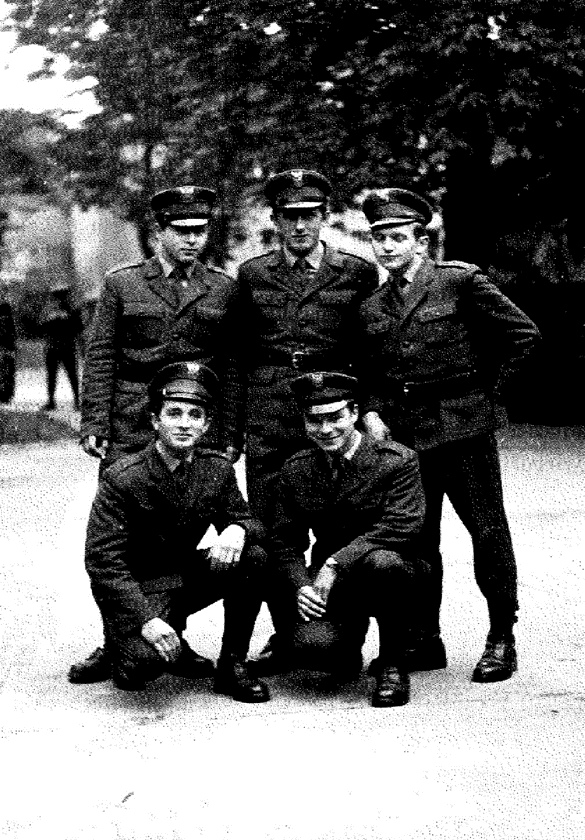 Alumn Piotr Przybylski and another cleric soldiers.
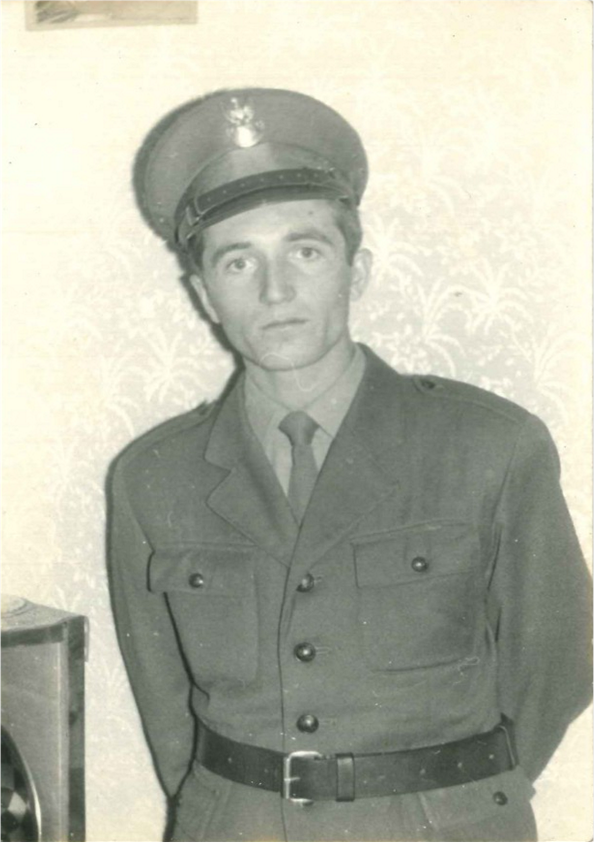 Alumn Piotr Przybylski during his military service.
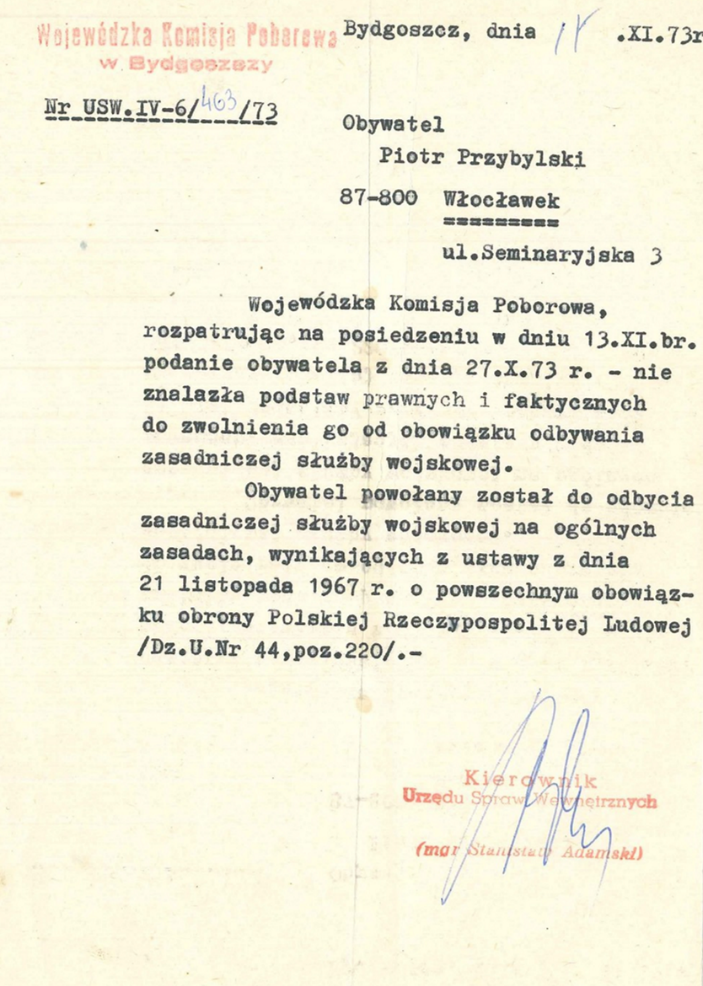 Answer from the Provincial Board of conscription in Bydgoszcz.
So there was an thought to call all the alumni into the army. It was intended to completely disorganize seminars and undermine the arguments of the church hierarchy, stating that the collection of any of the alumns into the military was a form of repression of the Church. This plan has never been implemented.
21 years of military experiment
From 1959 to 1964, alumns were individually incorporated into many military units throughout the country. However, this method was abandoned due to the fact that the clerics-soldiers exerted a very strong and affirmative influence on the another soldiers, becoming their spiritual leaders.
In 1965 the alleged "Claric Company" was created, which was located in Gdańsk, Opole and Szczecin-Podjuchy. In the same year, the company from Gdańsk was transferred to Bartoszice and the company from Opole to Brzeg. In 1966, all 3 companies were converted into independent military field rescue units. In 1973 there was no cleric unit in Podyuchy, and in 1979 in Brzeg. In April 1980, due to the expanding socio-economic crisis and pressures of the Polish Episcopal, the "people" authority solved the last cleric unit in Bartoszice.
With a stick and carrot
But how precisely would the military break future priests? First of all, prayer was banned in barracks and food was ordered on Fridays under the threat of severe penalties, e.g. detention for disobeying orders or severe physical exercises, consisting, among others, in tens of kilometers of moving with full equipment or organizing night alarms, depriving the clerics, even for respective days, of sleep.
Alumni training had small to do with appropriate military preparation. Despite the demolition of physical clerics, they frequently had more hours of indoctrination than training on the ground. For example, classes in shooting for Marxist lectures and talks were limited. In addition to group classes, there were besides four-eyed conversations, during which well-trained officers (most frequently party) tried to persuade seminarians to abandon the seminary, offering in return aid in uncovering a occupation or a place in a secular university.
The units organized more competitions and excursions to places related to the 1st and 2nd Armies of the Polish People's Army and communist guerrillas, workplaces, model GPRs, and, surprisingly, seminarians were encouraged to participate in events to which women were brought. They wanted to attract clerics in various ways to the secular world, as WSD itself noted, prohibiting seminarians from engaging in amusement activities.
Interestingly, letters from alumns reporting on another alumns were received to the WSD, informing about the inappropriate behaviour of their colleagues.
Chaplains in the Polish People's Army were besides utilized for political action. Very often, they were recruited from secret associates and quarreled with church authorities of priests. In military structures, they were subject to the Chief Political Board from which they received detailed instructions of conduct and then sent a detailed study to the Management Board. So it is no wonder that the chaplains in the barracks did not have a good reputation.
It is notable that alumni, compared to secular drafts, presented higher morale. As reported in their reports by their officers, the clergy distinguished themselves by discipline and exemplary performance of their duties. They had an intellectual advantage. They easy assimilated the training program and gained sympathy from many conscripts and any commanders. They set a good example, shunned profanity, were friends, helped, shared the received packages.
For their attitude was influenced by another clerics-soldiers, seminarians and local clergy, who commanded conscientiously to carry out their duties so as not to punish alumni and spread bad opinions about future priests.
Church and alumni did not stay passive
Knowing what the clergy meet in barracks, Rectors, bishops, as well as primates Stefan Wyszyński and then Archbishop of Kraków – Karol Wojtyła wrote letters to the authorities in defence of persecuted alumns, and besides held talks with any high-ranking politicians.
Some seminarians besides resisted. First of all, it consisted of organizing hunger strikes aimed at forcing the authorities of the unit of fundamental civilian rights, as well as conducting, despite the ban, common prayers. The another way of fighting was humor. Various, sometimes mocking, songs were created in barracks describing the barracks' destiny of the alumns. In the paper entitled Clerics in the Communist Army, directed by Stanisław Mark Królak and Elizabeth Szumiec -Zielinska we can hear:
War, war
What a woman you are.
That your craft, that your craft is taught by priests?
That your craft, that your craft is taught by priests?
North Poland
In the Bartoshite hole
Many clerics, many clerics are in uniform
Many clerics, many clerics are in uniform
The Rector is Gierek
Jabłoński Prefecture
And a priest's father and a priest's father Wojciech Jaruzelski
And a priest's father, and a priest's father, Wojciech Jaruzelski.
God, how somewhat you endure erstwhile you know that you endure for Christ
The most celebrated cleric who performed military service during the period of the Polish People's Republic was without a uncertainty priest Jerzy Popieluszko (Bartoszyce – 1966-1968). On 1 of the websites dedicated to him, letters were attached, which priest Popieluszko wrote to his parents and to the priest's father – priest Czesław Mietek. In a letter dated January 19, 1967, the future chaplain of Solidarity described the harassment he experienced in the military due to his relentless attitude:
The first 1 is simply a substance of military rosary. The rosary, as it turned out, was just a pretext. It started with the platoon commander telling me to take the rosary off my toe in front of the full platoon.
I refused, which means I didn't follow orders. And that's what the D.A. is threatening. If I took it off, it would look like a concession. The fact of the image itself is nothing. But I always look deeper. Then the commander ordered me to go with him to the higher authorities, and ordered his assistant to bring me to a business interview at 8:00. due to the fact that there were no higher authorities, he spoke to me alone. He threatened the DA.
He laughed: “What, a warrior for faith.” But it's nothing. At 17.45 p.m. in full uniform for the OCC [not leaving the barracks] I've become a C.O. There the test lasted until 8:00 with a dinner break. At 8:00 p.m., they were taken to the platoon commander. That's where it started. First he wrote down my data. Then he told me to take my shoes off, pull my shoelaces out of my shoes, and grow the time. So I stood barefoot in front of him.
Of course, always on alert. I stood like a convict. He started taking it out. He utilized different methods. He was trying to embarrass me. To be humiliated in front of your friends is to surprise again the anticipation of holidays and passes. I stood barefoot for an hr (60 minutes). My legs got cold, bruised, so he made me wear my shoes at 9:00. He left the area for a while and went to the boys (my platoon colleagues). He came for me with a comforting message: “There in the hall they pray for your intentions.”
Indeed, the boys were saying the rosary together. Rather, I gave him silence by praying in thought and offering suffering, caused by the overwhelming weight of the backpack, masks, weapons, and helmet, God, as atonement for sins. God, how somewhat you endure erstwhile you know that you endure for Christ. Like I said, the rosary was just an excuse to meet me in business form, due to the fact that usually I've already been on the phone. He only mentioned the rosary at the end of the conversation.
Oh, yeah, he kept talking about things that I had authority in the courtroom before, and now I'm a tool in the hands of others, cowards who are afraid to put themselves at risk. It's made-up, of course. Wanting a fight with your friends. But these are the kind of things we know. At 22.20 p.m., a political (polytruk) arrived, and he told me to take off my rosary with him. Why would you do that? I didn't take it off due to the fact that he didn't bother anyone, and I'm not taking it off due to the fact that individual can't look at it.
He fired me at 11:00. Wiesiek Wosiński was on work that night, so he helped me put my weapon in the magazine. I went to the sleep room. But I didn't have time to lie down erstwhile the squad leader declared my squad alert for me. On the alarm alternatively of 8-9 minutes. We were going 18 minutes. Then we set up in twos and went to the weapon magazine. So we were in line.
The platoon commander ordered the squad commander to bring me to this conversation with RKM around his neck, which weighs 15 kg next time. And the conversation will last not 3 hours, but from 4-5 hours utilizing appropriate methods. I'm to be put under peer review as a rebel. But luckily, I have good colleagues who sit in this court. They're expected to send a letter to the seminar with my opinion. I'm afraid it won't be very flattering [...].
JW 4446
Priests came from Koninska Land as well. 1 of them is, from Skulsk, parish priest of Lubstówek parish – Piotr Przybylski, who told me a very interesting communicative about his life in uniform:
I did my military service from 1973 to 1975 in JW 4446, Brzeg, close Opole. It was an entity devoid of combat character, targeted at field rescue, that is, to remove harm after raids, repair bridges and roads.
To this day, I don't know why I was taken into the army. I remember that from my yearbook there were 7 alumns (including myself). Why my yearbook? Most likely due to the fact that the then bishop of Włocławski – Jan Zaręba placed himself in power, erstwhile on the road from Włocławek towards Kutna the communists removed the cross from the roadside grave.
When I learned that I was to leave my Higher Seminary in Włocławek for 2 years, I immediately wrote an appeal against the decision on the conscription. Unfortunately, it didn't work. I received a answer to my letter, which indicated that I was called up “to execute essential military service on general terms, resulting from the Act of 21 November 1967 on the universal work to defend the Polish People's Republic /Journal of Laws No 44, item 220/”.
The authority did not treat seminars as universities. This, too, had to service 2 years, like another conscripts, while students of secular colleges who were taken for military training, had a résumé of not 2 years, but only 1 or 2 months, and this during the vacation period. Unlike us, after college, they were promoted to the first rank of reserve officer, and we could only number on the rank of Private and a mediocre monthly salary... The fortunate ones, at the end of the service, were besides decorated with the badge “The Model Soldier”.
As for the barracks life, it is worth knowing that the regulations of the unit in Brzeg were akin to those of non-cleric units: at 6:00 a.m. there was a wake-up call, later morning mortar, and then classes at the camp or dayroom. At 3:00 p.m., a mediocre dinner, followed by any leisure time, light school, and cleaning the unit's premises. Sometimes we besides worked in digging ditches and culverts for Poznań Road and Bridge Works Company.
There were besides organized trips, including to the Kłodzka Basin or the Brest Culture home (about all 2 weeks), e.g. for performances of singers and theatre.
Sunday was a day off. Those who then received one-time passes were most frequently going to Mass to the close St. Nicholas Church (they served for Mass in uniform), and later for a meal to the rectory. Those who had to stay in the barracks had so-called. The Mass was “dry”, that is, gathered in 1 semblance, and the liturgy of Mass was read 1 by 1 (because of the deficiency of Hostia – without communion). No priest with the Eucharist came to us on Sundays.
On the same day, the unit's authorities organized a cinema for us, during which historical, adventure and little frequently propaganda films were presented.
We had a lot more classes at the dayroom than another soldiers. There were meetings with political officers at the time, giving lectures in Marxist and Leninowski spirit. We were trying to show the alleged errors and contradictions in the teaching of the Catholic Church. Sometimes there were even discussions between alumns and officers.
Sometimes there were besides lectures with military chaplains who came to us in military uniforms, without collars or a cross on their chests. We didn't.
trust them at all.
The candle was besides a place where we could usage spiritual books sent by the seminary (of course, if the individual had approved them beforehand). In general, from what I remember, the alumni in Brzeg could have their Bible, medallion, or rosary.
At the dayroom, we besides utilized secret, hidden by the body itself, scripts that officers realized due to the fact that sometimes 1 of them would come into the area and check what we read.
On passes we sometimes went secretly to the Higher Seminary in Wrocław, where the prof. of a given faculty could pass an extraternistly exam, and after he passed the certificate. On the basis of these assessment certificates, they were entered in the Włocławek Index. That way, we didn't lose 2 years of studying, only a year. However, we had to be very careful not to run into officers of the Military interior Service on the platform.
The passes most frequently did not let to leave the Bank. Fortunately, they didn't catch me or any of my colleagues once. But if they were able to catch someone, he would endanger specified a delinquent for a week or 2 weeks in prison. Interestingly, the detention did not number as military service, so if 1 of the clergymen spent respective days or weeks there, those “sent” days later had to “work off” in the barracks.
You couldn't pray openly in my unit. So we did it secretly. We had to watch out for any non-cleric soldiers who had been eavesdropping and abruptly falling into the area where we prayed at the time and later reported the full incidental to officers. These conscripts were specially sent to our unit and then urged to track and study on alumns.
Despite the ban, we tried to pray, or at least to say goodbye, in the cafeteria before and after the meal, but then the corporal immediately rushed us to eat or to leave the cafeteria. I myself was punished for praying a five-day ban on leaving the unit. I had to check in with an officer all day. We could have sent and received letters, but we knew that any of them were viewed by officers, especially if they were letters to or from the rector or bishop.
Every cleric's behaviour has been recorded. Each folder was conducted, which was then sent to Włocławek after his military service. In addition to fear, we were besides tried to influence with a “good” word. I know a fellow officer offered to leave the seminary in exchange for help.
in getting into officer's school.
Just before leaving the barracks, the officer asked us if we were satisfied with military service. We all replied that we did not and that we felt hurt due to the fact that we were not treated as students, even though we were actually students. For this reason, we should not have been called into military service at all... We realized it was a fight with the Church...
In 2018 I received compensation from the Polish State through promotion to the first officer's degree. Many another clerics were besides promoted after years.
End
Several years ago, 3 volumes of books entitled: God is not God of war. Alumni Soldier Memories. The first volume included a list of erstwhile cleric soldiers (from 1959 to 1980) whose number, according to the authors of the book, was 2428... It is crucial to remember that many of these 2428 alumni have not given up the chosen way of life. The future priests treated the military as a time of martyrdom, trial, and science, through which they learned the mechanisms of the totalitarian system.
Ironically, the communists, who tried to draw them distant from the Church by various methods, yet made many of them strong opponents of communism...
Luke the Reverse
Source:
– Collective workGod is not God of war. Memories of alumni soldiers, Volume 1, Warsaw 2023, technological Publishing home of the University of Cardinal Stefan Wyszyński in Warsaw, pp. 119, 121, 182-183, 195, 289-326, 481, 505, 508, ISBN 978-83-8281-311-1;
– Andrzej Lesinski, Military service of clerics in PRL 1959-1980, Olsztyn 1995, Wojciech Kętrzyński investigation Centre in Olsztyn, pp. 20, 22, 24, 27, 29-37, 39-40, 46, 50-51, 79, ISSN 0585-3893;
- Bless you, Father. "Enjoy evil with good": https://kspieluszko.blogspot.com/2010/05/ks-jer-lists-z-military.html [accessed 22.10.2025, 20:21 p.m.];
– Documentary movie entitled Clerics in the communist army, Yeah. Stanisław Marek Królak, Elżbieta Szumiec-Zielinska, 2017 [online] – https://www.youtube.com/embed/u4QieHVJ2KQ [accessed 22.10.2020 at 21:20];
– Oral account of Father Piotr Przybylski, collected by Luke Revers on 11.10.2025.
We besides recommend: The French say that Poles conducted cultural cleansing in Ukrainians after WWII