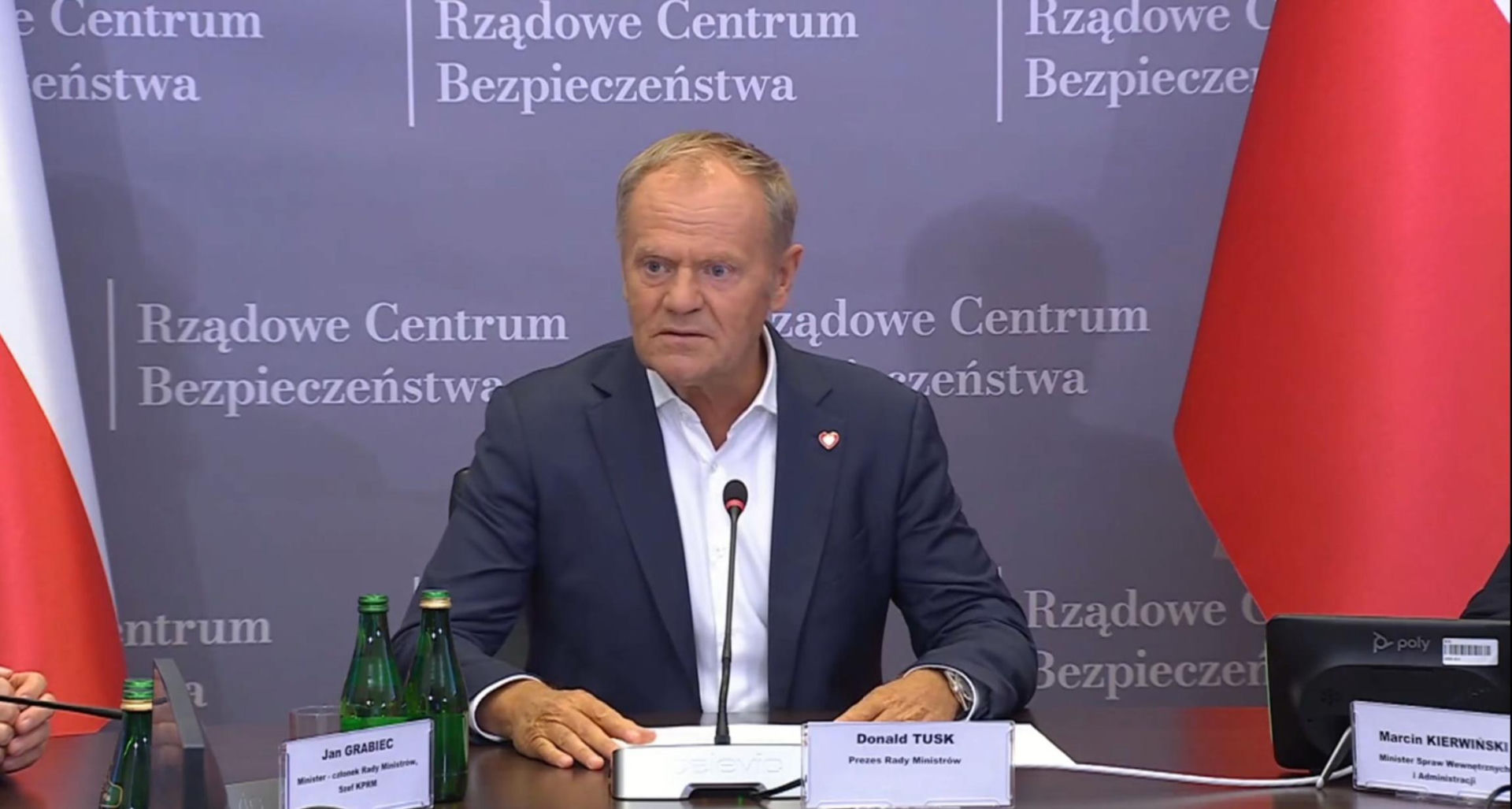
Of course, the full alleged democratic camp in Poland, Donald Tusk et Consoretes, Czarzasty and PSL, as well as the Warsaw salon and mainstream media. It's not a surprise.
But, by the way, as you say, it came out of the bag. People of the right hand who besides felt that the fall of Orban was a joyful message. I'll skip the sweat of a man Robert Winnickiwho tries to re-emerge as an active commentator on social media. Being no longer active in active politics, he does not gotta "pretend" – he writes alternatively what he thinks, and they are compromising the alleged National Movement from which he originates and from which he was wrongly, hope. In his opinion, Orban is “a disadvantage from the point of view of Polish interests, which went on a full collision course with ours (but besides in Hungarians, given the level of energy dependence of Budapest on 1 direction – Moscow), with your Polish interests, with a mouth full of trivial phrases about swords and glasses. Orban realized a imagination of the German-Russian Central Europe and imagined that something would come of it. Zero sentiment, only the Polish ration of the state with which Orban has been in a sharp short circuit for years".
Notice, this line of reasoning is 1 100 percent consistent with what the liberal mainstream pushes us regular – in the background, of course, Moscow, this morbid obsession not only with the camp of progress, but besides with the Polish “right”. This is the mention point for any assessments. Before the war, young people, or at least any of them, were betting on Hungary, but as an anti-Soviet state. They besides placed on the Ukrainian national movement, as our ally in the fight against the Soviets. The war has painfully verified it, but present people like Winnicki are returning to this compromised vision. The problem is that Hungary Orbana were not Hungarians before the war, Hungary Orbana became “endecious” and implemented realistic geopolitics in the Roman Dmowski style. And for these spatters from the mainstream national camp – it was a betrayal and a stone of paintings. alternatively of acknowledging the importance of the evolution of the Hungarian thought in this direction, they considered it contrary to the Polish interest, as they understood it. For them, “Polish business” is simply a confrontation with Russia, a full confrontation.
But Winnicki is, say colloquial, pimple. He spoke in the same kind of weight fighter much heavier, Sławomir Cenckiewicz, who would inactive appear to be the incarnation of “true” national thought. Here's his assessment of Orban:
"He was only an ally of Poland in the competition with cosmopolitans and centralists in the EU and in the issue of migration. It was important, but not enough. In addition, it only deepened contradictions – another perception of Russian threats, differences in perception of the North Atlantic alliance (about the function of Hungarians in the intelligence community will 1 day arise studies), completely incompatible with our interests energy policy (the fresh feats and trips of Mola to the Serbian marketplace in consultation with Russia), burying the thought of the Trimorese... Recordings of talks between the Hungarian Prime Minister and the head of the MFA with Putin and Lavrow late revealed (perhaps by 1 of the interviews) are an exemplification of all of this. Relativisation of this on the Polish anti-Russian right was a mistake (delicately speaking). possibly at least the mirrors will come to Hungary and another archival policies... In general, the Hungarian lesson should be examined by the right at various levels – from the issue of the real quality of this "soy".
The text could appear in “Gazeta Wyborcza”, “Political Critics” or “Newsweek”. Well, aside from this curiosal thesis that Orban "buried" the thought of the Indifferent Sea. No, Orban didn't bury her due to the fact that she never got any real shape. She was and is simply a Chimera, detached from the reality of the utopia sustained with persistence by the post-burialists of Polish prometeism and messianism, whose concept even Józef Piłsudski He didn't take it seriously. Many were spoken and written before the war, but after the war, the same people who preached this – they considered it a misunderstanding and rejected it erstwhile and for all to mention Wojciech Wasiutyński or Bolesław Piasecki. He who admits to any relation with the national camp and continues to keep this myth—is a pest and a pest. Only 1 concrete concept emerges from this “doctrine” – the thought of “ministers of the Ukrainian people”. And although people like Winnicki won't say it out loud, that's the reality.
If we are talking about who crashed, it is Poland, led by PiS, that destroyed the real Visegrad Group, choosing the madness of the "strategic" partnership with Ukraine and the unimportant Baltic states. This. Mateusz Morawiecki on request Jarosław Kaczyński he crashed the Visegrad Group, transforming it into a meaningless atrape, just due to the fact that Hungary Orbana did not accept as a dogma of pro-war hysteria, a program "supporting Ukraine as long as needed" and obsessive rusophobia. Therefore, I do not know what Cenckiewicz means, saying that "Polish anti-Russian right" must rethink everything and not relativize Hungarian heresy. I have already left out the usage of the word "anti-Russian right", due to the fact that it exposes and exposes the views of the author of these words. There is nothing "endecic" at this date. Before the war, even the top supporters of the Intermortal did not say they were anti-Russian – they said they were anti-bolshevik, and they always talked about Russia as a possible partner. present Cenckiewicz calls for a confrontation with Russia as if there was a USSR, having only a fresh form in the form of Russia Putin. This is simply a clear political and intellectual swindle, even considering the current sentiment of the Russian authorities to the USSR from planet War II. Finally, the “anti-Russian right” in Poland (PiS) has nothing to verify, it has always had rusophobia on banners, inspired by the tradition of left-wing PPS and masonry alternatively than the actual Polish right.
Jan Engelgard