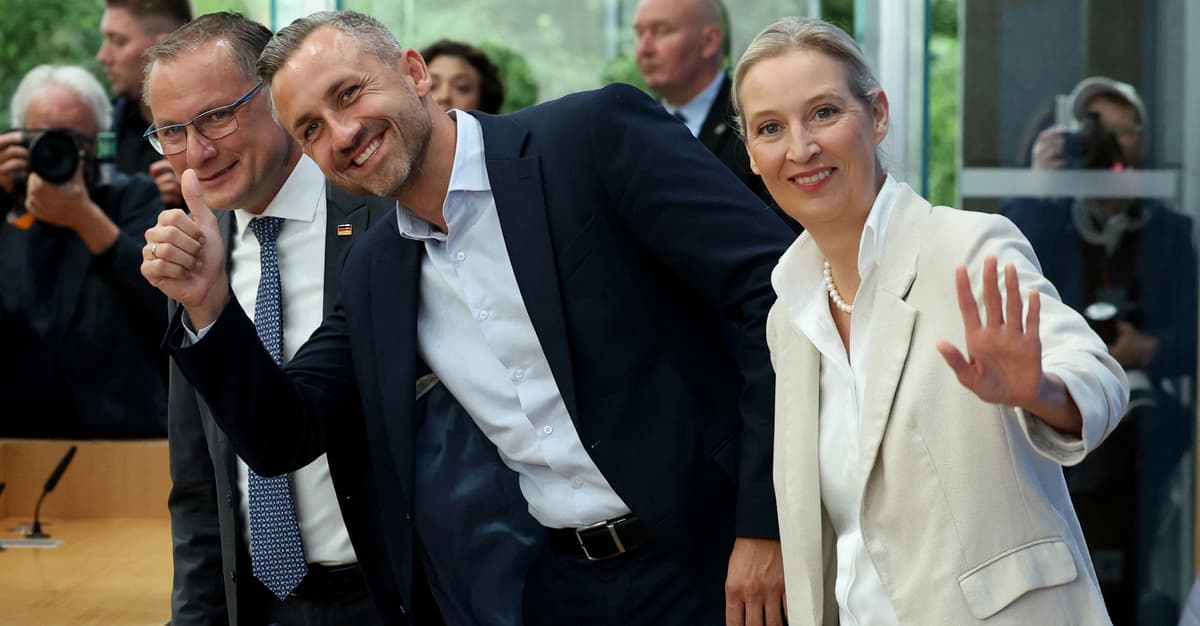
Events on the Turin political scene caused a immense shock in Berlin. Björn Höcke (AfD) publically offered Sahra Wagenknecht (BSW) support in the fight for the Land Prime Minister's seat.
For superficial observers, it's just cynical pragmatism and a tactical game calculated to break down the strategy sanitary cordon. However, at the metapolitical level, this Turin offer reveals a much deeper, historical and ideological bottom. It shifts the centre of gravity of the debate towards a phenomenon that has been fascinating for centuries and scares researchers of political thought: national Bolshevikism.
Turkish Gordian node: tactics and metapolitics
Björn Höcke's offer, the leader of the AfD structures in Thuringia, formulated to the Sahra Wagenknecht Alliance (BSW), seems paradoxical. The leader of the strongest, though isolated group, declared his willingness to quit his own ambition for a less-holding formation. In the classical language of cabinet politics, it is simply a decision calculated to exposure the BSW as a strategy organization ultimately, which, rejecting the coalition with the AfD, must enter into hard alliances with the chapede CDU. Höcke put it bluntly in his public address: "Mrs. Wagenknecht, if you are serious about the political change in Thuringia and the removal from power of the compromised cartel of the establishment party, we are ready to support you as Prime Minister. The real alternative, however, requires courage to break the taboo topics imposed from the outside".
However, in a metapolitical dimension – where concepts, a framework of discourse and long-term cultural trends are forged – Höcke's motion is revolutionary. This is an effort to test in practice the alleged horseshoe theory, according to which the utmost left and the utmost right approach each another in key moments of civilizational solstice. Through this Turkish movement, AfD attempts to integrate 2 seemingly contradictory electorates: “Eastern German”, conventional anti-immigration right-wing sentiment with social nostalgia, anti-capitalism and pacifism of the fresh Wagenknecht left.
The spectrum of Ernst Niekisch and German national Bolshevikism
To realize this mechanism, we request to go back to the turbulent period of the Weimar Republic and look at the concept of national Bolshevikism. His key theorist in Germany was Ernst Niekisch – Initially a social democratic activist and associate in the Bavarian Revolution, the publisher of the magazine "Widerstand", which made a unique synthesis of extremist nationalism with elements of Marxism-Leninism. Niekisch felt that the top enemy of the German people was not communist Russia, but liberal-capitalist West, represented by the dictatorship of the Treaty of Versailles, marketplace oligarchy and decadent, bourgeois individualism. It advocated a full Prussian state based on a planned economy, a militarized working society and ruthless opposition to western liberal democracy. The key component of Niekisch's doctrine was Orientsorientierung (Eastern orientation) – a geopolitical alliance between Germany and the russian Union. In the national-bolshevik perspective, Russia, despite its communist face, was seen as an primal, anti-Western and organic force, capable of helping Germany to drop Wall Street and redefin European order. Niekisch wrote explicitly that Germany must choose between "Western distribution and east order and discipline".
Ex GDR specificity – fertile dirt for syncretism
Why are these weimar spirits waking up in Thuringia, Saxony or Brandenburg? East Germany (ex GDR) is simply a unique political laboratory which is drastically different from the western lands. The process of "unification" that has been going on for decades has failed to obscure deep identity and socio-economic differences. The inhabitants of the erstwhile GDR carry a profoundly rooted sense of being “second-class citizens” whose life and identity were colonized after 1989 by West German capital and political elites. This systemic frustration spawned a circumstantial psychosocial mix: a strong longing for state care (social stableness from the GDR) combined with aversion to Western liberal moral experiments, mass migration and globalisation. Moreover, east German political culture is characterized by traditional, historical empathy towards Russia. While the Atlantic doctrine prevailed in the West, decades of proximity to Moscow – paradoxically – left behind not only trauma, but besides deep anti-Americanism and distrust of NATO. It is here that the slogans "the mediate East room" and "German sovereignty" fall on the most susceptible ground. Both AfD and BSW realize perfectly that East German voters are not looking for pure marketplace doctrine or pure Marxism – they are looking for a defence from the outside world.
Hysteria in Berlin. CDU and SPD reactions
For Berlin, Höcke's Turkish offer is the fulfillment of the worst nightmare about the "red-brown" front that can permanently destabilise the national Republic. The reaction of the mainstream organization exposed a deep panic establishmentwho loses control of the political ceiling in the East. Chadetia (CDU) reacted with rage and immediate rigidity of rhetoric. CDU leaders have identified the AfD proposal as “a pact with the devil” and “an attack on the foundations of German democracy”. For chadeks who themselves desperately effort to build a coalition with the BSW, just to remove AfD from power, Höcke's movement is simply a powerful tactical blow. It shows that Wagenknecht – if he enters into the deal with the CDU – will become in the eyes of east voters "a traitor of the anti-system revolution". In turn, a deep crisis of social democracy (SPD) reacted in a speech of moral uplift. The representatives of the Chancellor's organization are thundering about "reviving the darkest demons of German history". For the SPD, the national-bolshevik syncretism of Turin is the eventual proof that Wagenknecht has completely left the orbit of the democratic left. The SPD office in Berlin warns that the alliance of anti-Western pacifism with ethnonationalism is simply a simple way to vassalize Germany towards the Kremlin and dismantle the European Union.
Cordon breach. The fresh Right Perspective
While Liberal establishment Trembles in front of Turin flirtation, the intellectual base of the fresh Right (Neue Rechte) accepts this decision with undiscovered satisfaction. For strategies focused around the Institute of State Policy (Institut für StaatspolitikIn Schnellrod or the "Sesion", Höcke's proposal is no coincidence – it is simply a long-awaited implementation of their own metapolitical agenda. From the point of view of the fresh Right, the conventional division into “left” and “right” is simply a 19th-century outage, artificially sustained by the strategy to share social resistance. The actual front line present runs between a globalist, liberal-capitalist center (Berlin, Brussels, Washington) and a sovereign, identity-based periphery. fresh Right has for years advocated the construction of so-called. Querfront – a transverse front combining the social radicalism of the left with the identity traditionalism of the right. For fresh Right-wing publicists Wagenknecht is simply a key figure. It sees not a Marxist but a "leftist conservative" who, as 1 of the fewer on that side, understood that without the defence of a nation, borders and culture, it is impossible to defend workers' rights against the fight of global corporations. In the optics of the fresh Right, Höcke's motion yet burys the liberal story of the "sanitary cordon". Even if Wagenknecht rejected this offer for tactical reasons, speaking of "unimportant play", the specified fact that specified a proposal fell has irreparably shifted the limits of what was imaginable in German politics. "Better to be a sinner fighting this time together with demons than a saint compromising with him. all alliance is acceptable against the bourgeois order," he wrote Ernst Jünger (Widerstand, 1930).
Anatomy of Modern Syncretic Populism
Is classical national Bolshevikism born in Thuringia? Modern political discipline prefers to usage terms specified as syncretic populism or leftist conservatism. Today's reality differs from the reality of the 1920s. Neither Wagenknecht strives to nationalise manufacture in the russian way (it refers alternatively to postwar German ordliberalism Ludwig Erhard), neither Höcke has paramilitary kind fighters Freikorps. Above all, however, revolutionary symmetry is lacking. Ernst Niekisch wanted to overthrow the capitalist strategy by force; modern AfD and BSW operate within democratic structures, utilizing frustration of the electorate battered by inflationary crises, energy transformation (Energiewende) and migration fears. These events show that the old liberal consensus breaks before our eyes.Höcke's motion towards Wagenknecht is simply a powerful metapolitic impulse, proving that for anti-system forces ideological dogmas from the past weigh little than the common enemy. intellectual taboos in the ex GDR lands broke – the spirit of national-social synthesis left the Weimary archives and for good infected the modern political discourse of the West Germany.
Matthäus Golla